
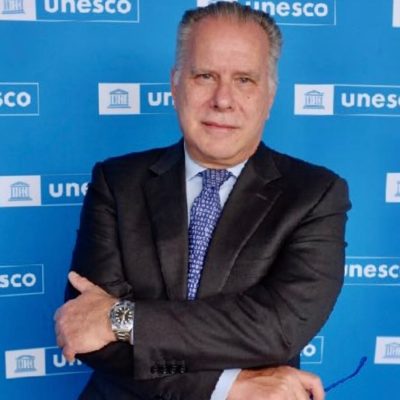
Yiorgos Koumoutsakos, Greece’s Ambassador to UNESCO, who led the initiative to establish 9 February as World Greek Language Day, stated that Greece now holds a “golden international passport” to carry the Greek language across the world and to leverage it for the benefit of the country. He was speaking on Voice of Greece radio, on the program “Our Global Voice” with Dimitris Kontogiannis.
Mr. Koumoutsakos stressed that Greek is “a 3,000-year-old adolescent” that exerts a unique cultural appeal, as it is the vehicle of the great concepts and terms of human civilization. He described UNESCO’s decision as historic and unique, noting that it was not based on how many people speak the language—the quantitative criterion—but on a qualitative one, recognizing the brilliance of Greek’s contribution to human culture. UNESCO, he added, acknowledges the universal character of the Greek language, underlining that it is a point of reference for countries and people we might not even imagine.
The Ambassador also referred to the strong interventions made by representatives of countries such as Poland and Morocco in support of recognizing Greek as a world language. The Moroccan ambassador cited the French writer Marguerite Yourcenar, who had stated that “whatever is most admirable and greatest ever said by humankind has been said in Greek.” Mr. Koumoutsakos clarified that it was a Greek initiative—like Haiti, the first country to recognize the Greek Revolution and the Greek state—to make the first intervention at the UNESCO session.
He emphasized that culture, language, and shipping are the sectors that can give Greece international reach and influence, and that these should be fully leveraged. Regarding the use of World Greek Language Day in particular, he mentioned ideas such as the creation of a Council for the Promotion of the Greek Language, and found especially interesting the proposal by Emeritus Professor Anastasios Tamis to establish a global fund for promoting Greek worldwide, supported by members of the Greek diaspora and possibly the state.
Mr. Koumoutsakos praised the often unseen contribution of scholars and academics—including Christos Klairis (Paris), Giorgos Babiniotis (Athens), Anastasios Tamis (Australia), Mr. Korinthios (Italy), and Academician Mr. Kounadis—to the successful outcome of the effort. “We transformed scholarly knowledge into diplomatic action, into a diplomatic strategy,” he said, “and achieved a result of which we are all proud.”
Referring to the event organized the previous evening by Greece’s Permanent Delegation to mark World Greek Language Day at UNESCO headquarters, the Ambassador noted the strong public interest: around 1,700 people had registered in advance, more than 60% of them non-Greek. The evening was to begin with the opening of an exhibition by the Ministry of Culture on the Greek language and script, inaugurated by Minister Lina Mendoni. This would be followed by readings of seven texts—from Pericles to Odysseas Elytis—and a musical program featuring Mario Frangoulis, the rising Greek-French singer Daphne Kritharas, and an orchestra from the Corfu Music School, among others.