
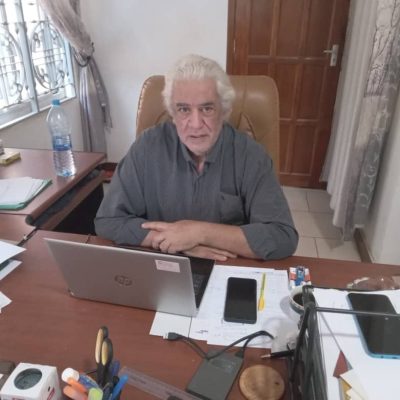
Dr. Ioannis Loukas, a member of the Greek diaspora who was born in the Democratic Republic of the Congo, studied and taught at universities in Europe and elsewhere before returning to Africa. Now one of the driving forces behind the establishment of the first Pan-African Greek Orthodox University in Tanzania, he joined Dimitris Kontogiannis on Voice of Greece’s “Our Global Voice” to discuss the vision behind the ambitious initiative, its progress, and the challenges it faces.
Dr. Loukas reflected on his academic journey and spoke about the College of Social Studies, which he currently leads, as well as the Pan-African Patriarchal Orthodox University “Saint Nektarios.” The university’s campus has already been completed and is awaiting final approval from the Tanzanian government before opening with three initial schools: Theology, Business and Commerce, and Social Sciences. The project is supported by the Greek Orthodox Archdiocese of America.
The English-language university will also offer instruction in the Greek language and aims to provide high-quality education to students from Tanzania, across Africa, and other countries, including Greece, while promoting Greek Orthodox culture and values.
In addition to the academic facilities, student housing has already been completed. Dr. Loukas noted that the total monthly cost of tuition, accommodation, and meals is expected to remain below €500. He also revealed that cooperation agreements have already been signed with several Greek universities—including the Aristotle University of Thessaloniki, Democritus University of Thrace, and the International Hellenic University—to support the curriculum, faculty exchanges, and the institution’s future academic recognition in Europe.
Concluding the interview, Dr. Loukas appealed to anyone wishing to support the project, particularly through financial contributions, stressing that significant resources are needed to sustain and expand the university. He also described the demanding conditions faced by local communities, including prolonged outages of water, electricity, and internet services, widespread poverty, and the abandonment of children whose families are unable to support them. He highlighted the broader humanitarian work of the Orthodox mission in Bukoba, including its modern medical center and plans to establish a nursing college.